Curiosity in fact does not necessarily kill the cat

pexels-photo-large

My latest addition to in the Economic & Commercial section of changeisanopportunity.info is around leadership and the role of learning. I’ve been musing on tolerance of ambiguity a lot – not least because when I mention the fundamental nature of this as a leadership characteristic in my foresight sessions and workshops with clients, it resonates really well with senior teams. And yet, there seems to be very little published on it.

I was first introduced to the concept by friends at Futureworld from where I found this paper. And a few years ago I started to think about the issues of mindfulness, spirituality, aesthetic judgement and creativity not from an academic perspective but from the practical. It seemed to me that none of this was possible without the concept of a learning mindset (the ability to recognise that what we know is by no means all we need to know as well as the possibility of change) and behind that curiosity. So I was fascinated to see that a recent post and survey has recognised exactly that.

The post makes reference to how difficult it is for conventional leaders to be curious and I would echo that – in my many foresight sessions, many of the leadership teams I’ve worked with want to go straight to the ‘so what’ and even more so the ‘now what’ – the action arising. Without really showing any curiosity as to what lies behind a multitude of megatrends.

Nor do I believe that the sole reason for being curious and open minded lies only in the ability to be innovative and have new ideas. I think there is an equal and potentially opposite need to be curious for risk management purposes. After all, without curiosity to seek out what new competitors or new technologies have to offer, and the humility to expect disruption, how will organisations spot the issue until it is too late?


From scarcity to abundance

SONY DSC

My last post focused on tolerance of ambiguity – my latest ‘card’ on the shift from scarcity to abundance – in this instance in relation to the potential impact of 3D printing on replacement human organs.  And to me there is an enormous link between the two. Really since the dawn of mass commercialisation, our business models have been predicated on scarcity – even mass manufacturing serving really to highlight how appetites stimulated by scarcity and rarity (not that many Maseratis are made) can be met by cheaper mass produced models (the model T Ford being the classic). The decisions around operating models and pricing are therefore linked to how scarce I choose / have to make my offering. When I worked in research level publishing, there simply weren’t that many libraries / institutions working in some of the fields that we published – so the price of those books was geared to the tiny market size. Equally, Rolls Royce choose to create an incredibly high class product and charge accordingly in comparison with smaller and more mass market cars. Whilst the optimum decision is not necessarily easy the model is widespread and established.

But just look at how many assumptions are challenged in the business models based on abundance. Assets are owned not by the customer but by the providers / suppliers who may also be users / viewers /customers. Pricing is more transparently related to quality but is not necessarily homogeneous (think about the range of prices on Airbnb for example). Audiences are less mass market segments and more about tribes – tribes whose values may be similar within themselves, but where the values from one tribe to another may vary hugely. And abundance is opening up markets that never existed previously – how many of the artists and craftsmen on Etsy would previously have had a global market available to them?

And this requires a huge tolerance of ambiguity around business models – the recognition that pricing and marketing principles that worked well in the past will no longer be optimal necessarily in the future. Other people’s views (especially if more comfortable in the digital arena) may be as, if not more, valid. And new competition may arise not only from left field but within timeframes that we traditionally think of as project cycles at best.

In this context tolerance of ambiguity is really about the ability to question the status quo, to reassess fundamental assumptions (many of which are not even necessarily overt assumptions), to be humble enough to admit that not only does one not have all the right answers but that for some questions there are in fact multiple right answers. Because part of the problem with tolerance of ambiguity is understanding just what the phrase means . . .

Alternative futures

city-cars-road-traffic-medium

In my talks on megatrends I almost always finish on what I think is the key leadership skill of the future – tolerance of ambiguity. And it is beginning to dawn on me just how difficult / rare this is to find in business. This week I was talking at a global mobility conference – concerned with the ability to provide people around the globe in timely, productive and cost effective fashion. So demographics, technology, working patterns, automation etc were all discussed. But at the end of the day, my suspicion was that most people wanted to know the answer to a binary question – in the future will we or won’t we move people around the world to work?

I have every sympathy with the group tasked with achieving that today – after all international regulations, tax jurisdictions, budgets, pace of change, pressure on talent are all factors which make this hugely difficult. But when you look forward it seems to me that there is only one real answer to their question – Yes and No. Meaning that there will still be roles for which the personal, hands on, physical presence is essential, but at the same time there will be other roles which have traditionally been done in person which can be handled remotely or through an alternative route.

This is by no means a unique example – it just happens to be the one that is current to me this week. And it illustrates the business mind set – to pretty much all commercial questions there needs to be a one size fits all (and hence definitive) answer. But what is increasingly clear is that there are many alternative futures and technology is presenting us with more options all the time. At the same time, customers and users are becoming more demanding, have higher expectations and are accustomed to ever more levels of personalisation, whether in terms of product, service or experience. The one size fits all option is therefore highly unlikely to be the right way to go either from the demand or supply side. So many questions may get answered with Yes and No.

And that is where the tolerance of ambiguity comes in because so much of the corporate infrastructure is designed to create efficiency – efficiency which is predicated on economies of scale. And in the same way that the internet has created abundance (rather than scarcity) in terms of markets, it seems to me have created abundance in terms of solutions. Finding the right match for the right customer therefore goes beyond the efficient here’s the one and only solution, to the agile and adaptable – how can we have a basket of options that handle what our customers want in an efficient way?  The discussion of such agility tends to move rapidly to digital enablement, technology solutions, platforms, automation etc but it seems to me that culturally agility is simply not comfortable for many people’s mind set. The possibility of providing multiple options with the same (or better) levels of efficiency as before sits in the ‘does not compute’ box.

And none of this is surprising – tolerance of ambiguity has never been high on the list of attributes for high performance historically. Decisiveness, clarity of vision and purposeful action are all much easier and comfortable to recognise and deal with. So, in amongst the rest of the issues around creating agility, how to achieve a mind set shift to tolerate ambiguity, alternative futures, or solutions which feel radically different (potentially impossible\) to history becomes a major hurdle.

Faster than fairies, faster than witches

From a railway carriage – by Robert Louis Stevenson. A poem of its time, when the railways were amazing people with their speed (faster even than the supernatural) and at the same time democratising travel. We’re living in similar times today – my latest ‘card’ on CIAO is on geolocation / GPS which is one of those innovations that like train travel begins as a marvel and rapidly becomes the norm. I was visiting Seaton Delaval over the weekend and not only used my phone to direct me there but also realised that the National Trust app was showing me details of the nearest other properties and included Belsay Hall (English Heritage not National Trust).

All very well I hear you say but what’s the point. Well it occurred to me that so much of this data (like the application of Waze to satnavs) is happening without our really recognising what’s going on. We are just becoming very used to having contextual information provided as we move around – and increasingly expecting added value data to complement the central question we may have asked or is implicit. So we ask about local restaurants and burger bars and get not only the information but also which ones friends have liked or where we went to something similar recently. And all of this is changing our behaviour in some really subtle ways.

First, we no longer need to frame the right question – we can be much more lax about the key enquiry as our devices will supplement the answer with a raft of related information. Secondly, we don’t need to remember anything – our history (and our friends history) are increasingly available to us on our devices. Thirdly, all of this is in real time, so our need to organise in advance is also reduced. All of these might sound trivial but on a large scale they change how we think, how and what we remember and how we plan our days.

And, as I suggest on the ‘card’, all of this may be fine if we are all in the same boat but what about those without smart technology. As life evolves (especially with the advent of sensors and the internet of things) there will be an implicit assumption that everyone is sharing these behaviours, and all have access to smart devices. Over time of course this may be true (especially as technology becomes automated and less user triggered) but the interim is different. You only need to look at how many older cars are still on the road to see that not everyone can or will change at the same speed.

GPS

Means and ends

Mckinsey's circular economy

It would be fantastic if we all delivered work, lived our lives, bought stuff etc etc for the right reasons. But sometimes, the right reasons aren’t enough. Climate change and the environmental consequences have been discussed for many years, and many people understand that in an ideal world, we should all use less energy, less water, eat less food and so on. At the conceptual level, there are few who would not subscribe to the view that we should always, indeed must, consider future generations. And yet, it is clear from the limited changes to date that environmental concerns, and debates about impact are insufficient to change behaviours substantially.

At the organisational level, financial and commercial drivers sit more comfortably with day to day strategies and tactics. And increasingly environmental issues have a direct earnings or profitability impact. Interestingly these are by no means all negative. So on the risk side, the Thai floods of 2011 are illustrative of the issues:

  • A single extreme climatic event flooded three quarters of the world’s hard disc drive production.
  • We began to wake up to the fact that HDDs were not just in computers, but cars, entertainment etc – the immediate production implications were huge and for the organisations themselves the loss of profitability substantial
  • But it created an awareness of the systemic nature of risks – and put external risks firmly at the centre of the attention of analysts and market commentators, impacting share prices and market valuations as well as the immediate P&L
  • Finally it engendered more innovation and investment in storage since solid state drives have increasingly become cheaper and more accessible since 2011

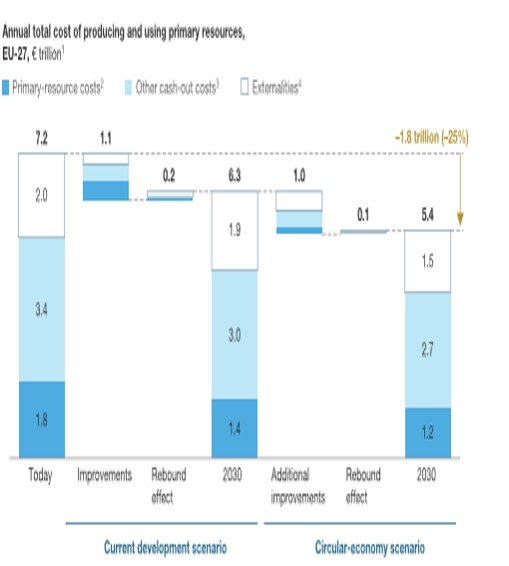
But what about opportunity? The McKinsey report in Sept 2015 on Europe’s circular economy opportunity illustrates that addressing environmental concerns through recycling, repurposing and making supply chains more efficient can provide huge returns. This is therefore a real opportunity as well as an essential move. And beyond the direct economic benefits, the rise of the collaborative consumption economy fuelled in part by a desire by some consumers to use less, have less of an environmental impact and make more of what we already have is a further indication of the commercial opportunity here.

Faster and broader

userbase

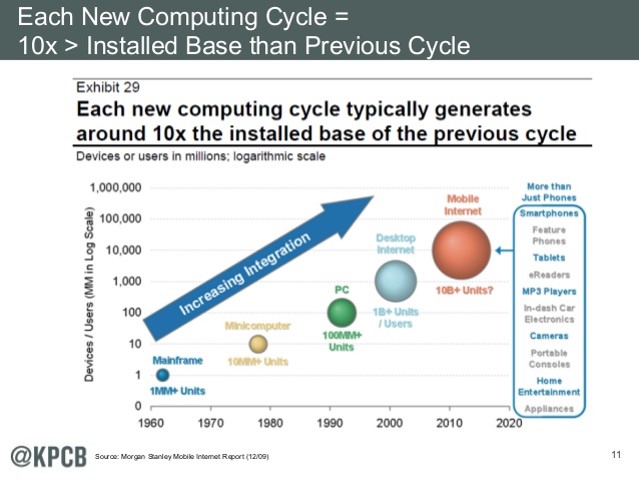
It was this evidence of the broadening impact of each successive wave of technology that I talked about in my last ‘card’ on the CIAO website. And it links strongly with BreakingSmart which I am still digesting but which seems to me to develop and refine these simple statistics further. Venkat Rao discusses in his first essay how software (and more specifically Marc Andreessen’s view that ‘software is eating the world’) relates to previous innovations – only two of which, written language and money were ‘soft’ technologies. I will make no attempt to paraphrase the great story told in BreakingSmart, but the point that software (in the form of the internet and the applications which leverage it) is enabling faster and broader impact across the globe.

And I think it is interesting to compare this to previous such revolutions – take electricity for example.The focus is inevitably on the pure technology in the beginning. Punch in 1848 has this to say:

LIGHTS! LIGHTS! I SAY!

INSTEAD of there being the slightest chance that wonders will ever cease, we have strong reasons for thinking that wonders have only just begun. The last new marvel is a Company for lighting our streets, our shops, our houses, and even our bed-candlesticks with electric fluid, so that we may sit, and read or write by flashes of lightning, and go to sleep with a column of electric fluid doing duty for a rushlight in our room. The new lights that have sprung up within the last few years have been extinguishing and snuffing each other out in rapid succession. The first breath of science blew out the dips, which fell prostrate under the wand of discovery, and then came the metallic wicks, offering “metal more attractive” than the cotton, of whose existence ingenuity has at last cut the thread. Chemistry then took the candles in hand and superseded with the composite fashion the once popular “mould of form,” until the public, having noted the presence of arsenic, stopped its nostrils and its patronage. The electric light now threatens to supersede all, and considering the universal use now made of electricity, we should not be surprised at the formation of a Company to fix a lightning conductor instead of the ordinary conductor to every omnibus.

Punch, Jul.-Dec. 1848

What is blindingly clear from this is just how difficult it was in 1848 to predict what and how electricity would do to promote growth and change. Instead the focus is on how it changes the ‘how’ of every day activities. There is no reference to the ability of the technology to create entirely new industries (both in power generation and in the application of electricity) nor of the dependence that electricity would increasingly provoke as it became a ubiquitous utility. Thinking about the digital universe we seem to be not much further than our own 1848 position now – in KPCB Mary Meeker’s Internet Trends 2015 she says “Whilst consumer internet entrepreneurs often pursue personal passion, ‘Enterprise’ internet entrepreneurs often pursue prior company pain points’ and we in the corporate world still seem to be seeking in many ways to deal with the issues of today or even the past, rather than the opportunities of the future. As a result there sometimes seems to be an increasing divide between the new opportunistic talent and a corporate rear-guard.

But as electricity shows us the two either marry up, or the former outstrips the other – giving rise to the next step change in growth.

Bought by many

boughtbymany

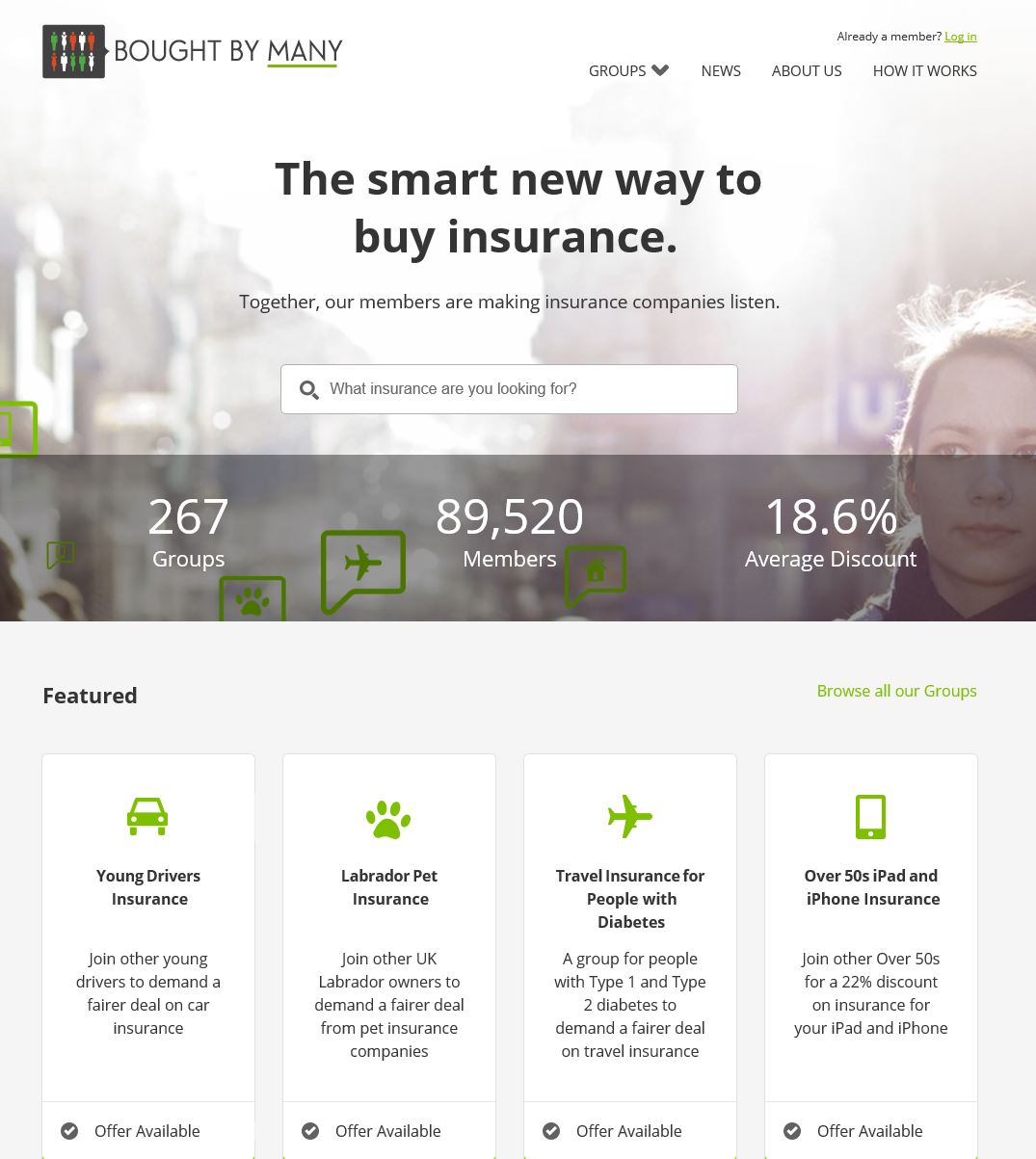
My latest card on CIAO is on ‘bought by many’ insurance as an example of how global connectivity is driving commercial shifts in conventional business models. And of course in this instance it is very reminiscent of the old mutual funds of the industrial revolution, with people (in this case in close geographic rather than virtual) in close proximity grouping together to create a protective mutual fund.

And that triggered a thought as to what else was a new invention of an old model. After all, Guest Houses and Bed & Breakfast offers have been around for decades without anyone suggesting that the hotel industry is under threat globally. And the auction model behind eBay is centuries old. So what is it that is truly different if it isn’t the product underlying the transaction?

It is to my mind another example of experience overtaking service which has overtaken product as the key attribute of any transaction. That experience can be made up of many things, some of which are not really related to the transaction at all – the experience of browsing AirBnB for example feeds dreams of holidays as much as it does provide a solution.

Choice too is part of the experience – the choice of global offerings (Etsy being a prime example) rather than local or national. And of course convenience – all done with a few clicks rather than needing to visit or phone.

So I started to think about what else that experience offers – how far in the value chain does it extend? In the case of AirBnB you may not actually be wanting or needing to travel at all – browsing through where you might go can happen in the absence of any specific trip (although it may then become a trigger for that trip). So that extends the journey in advance of a specific transaction, And similarly, getting to know the owners of where you stay may result in new friends – extending the chain well beyond the specific visit.

Experience is becoming key for customers but increasingly I think it offers huge value to providers and suppliers too, in creating extended and different value chains for old models. Numerous new points of contact with customers, and opportunities to build the relationship. So perhaps these are new models rather than just reinventions of old . . . .

More or less helpful

looking through

I’ve been feeling that weather forecasts have become less helpful recently (that’s a purely personal and subjective view, albeit influenced I suspect by the fact that the great British summer has not exactly materialised this year!). But what does appear to be real is that forecasters are talking more about probabilities – eg ‘this is the most likely scenario but it is possible that. . . . ‘

And that’s set me thinking about Daniel Kahenman’s Thinking Fast and Slow and how one of the things that our System 1 thinking struggles with is probabilities. So, does offering people information that says it will probably be X but could be Y actually help in making better decisions or not? I am not qualified to comment from any specific scientific angle, but my experience of getting people to make decisions, particularly difficult ones in an environment of change is that alternatives, particularly those that involve probabilities are less than helpful. So, in weather terms, it may be that more information is really less, in terms of value offered, even if at the end of the day the actual view offered is technically more accurate. Knowing that X is materially more probable than Y is not at all the same thing from a decision making perspective as X is right and Y is wrong. And yet, to a great extent that is how many are using the data when they hear it.

I think there are lessons here for using data wisely. The ability to draw conclusions from data and analytics often will throw up the probability of a trend, or an event – but for whom is that information helpful? One of the reasons sites like Trip Advisor work for people is that the element of probability is removed – we trust people like me to make the same decisions as us – indeed in many cases to make the decisions for us in practice. Am I advocating this? No I’m not, but I think as we use data more and more, and we throw up trends and probabilities we need to get a good deal better at dealing with those as probabilities, rather than the black and white world of yes and no. I am for example an advocate of scenario planning as much because of its ability to help people understand that there are many possible variations of the future – some more probable than others but none absolutely and categorically right.

And speaking as someone who for varied and unplanned reasons has studied statistics at multiple points in my life, I have to say that certainly the way I was educated about them was of no help in thinking about probabilities and certainties in very different ways.  If there are ‘Lies, damned lies and statistics’ (popularised by Mark Twain but attributed to many originally) then what can we say about data? Where does that sit on the spectrum?

Parallel tracks

Alternative finance

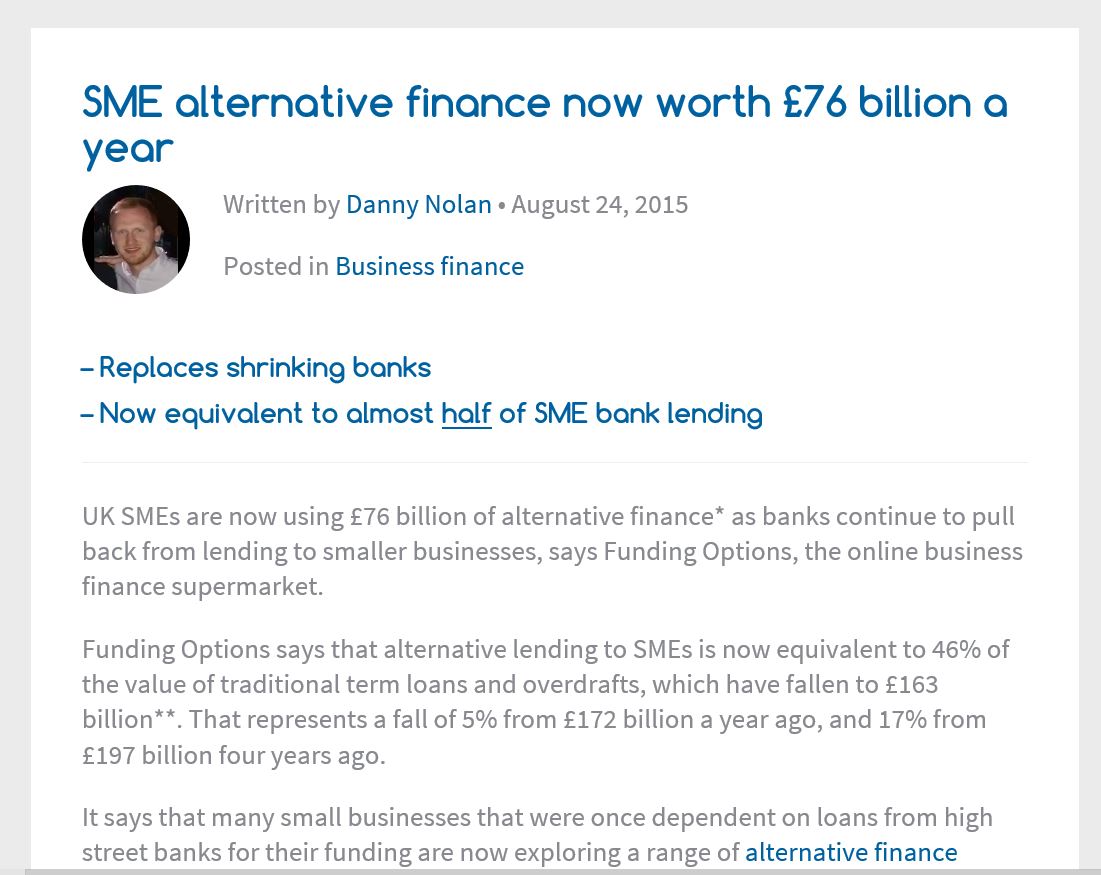
Picking up on a recent post by Future Options, the rapid adoption of so called alternative finance to the point where it now represents nearly 50% of funding to SMEs is typical of the disruptive nature of these parallel businesses. It is tempting to see the democratisation of finance as simply a beneficiary of technology enabled start ups in crowd funding and the like but in reality the situation is much more complex.

The shift, particularly for SME funding, has much to do with the aftermath of the financial crisis and the regulatory response to that as well as new opportunities and is itself illustrative of the dilemma faced by traditional businesses, not just in financing. Significant funds are needed to maintain legacy businesses (especially as this post suggests, those built through M&A) and the entire structures, processes and culture of conventional business has been built with scale rather than agility in mind. And, with known business models, regulators are in a position to respond with policy and rules which reflect and build on what’s gone before rather than the new.

So is this really a question of old vs new? Simply a cyclical change which sees the replacement of the old guard? In practice it seems unlikely when the wider picture is considered. When I was doing a post graduate diploma in printing studies in 1980 electronic typesetting was coming in and the death of the newspaper was predicted within 5 years. Publishing has indeed changed significantly – but not within 5 years and not with the complete death of newspapers. Any more than radio or TV has died completely. Instead niches develop – mainstream moves on, but there are environments, activities and tribes for whom conventional models make sense. None of the traditional media is unscathed, or in the identical format, but they still exist and indeed in some cases are thriving.

There is also the case, going back to financing, as to what it is that is being financed. Many new businesses require significantly lower levels of capital than in previous start ups (limited hardware for example). M&A has not returned to being the mainstay of growth in the way of the 90s and hence the type of financing appropriate for that is unlikely to be as predominant. And the big acquisitions in the tech space at least are frequently made by corporates with cash filled balance sheets.

Alternative may indeed be the wrong name, but the broadening of funding opportunities to support SMEs in particular is a welcome one and has its parallels in many other sectors where new approaches are growing alongside old models. I have classified this trend under agile responses – as the increase in options can only benefit more companies.

The Promethean Teal – rara avis

bird

If my posts this week seem a little vague it is probably because my brain is full. I’ve just finished both Frederic Laloux’s Reinventing Organisations and Breaking Smart Session 1 by Venkatesh Rao. Both have so much food for thought in them and on the face of it, little in common per se. And yet, put together with much of what John Hagel talks about I think there is much serendipity in reading them in close proximity. So this is a brief post to bring these to your attention – more to come I suspect when my brain has done digesting . . . .